
How the Hail Mary Ship Actually Works: Astrophage as Rocket Fuel
How does the Hail Mary ship work? Astrophage fuel stores energy near the E=mc² theoretical limit, powering a photon drive across 12 light-years to Tau Ceti. A breakdown of the real physics behind Andy Weir's interstellar spacecraft in Project Hail Mary.

Andy Weir has a gift for making fictional spacecraft feel buildable. In The Martian, the Hermes was a rotating-ring vessel powered by ion drives — speculative, but rooted in hardware NASA has actually tested. In Project Hail Mary (opens in a new tab), he goes further. The ship that carries Ryland Grace across twelve light-years to Tau Ceti isn't powered by fusion, fission, or antimatter. It's powered by a microorganism. And somehow, the engineering makes sense.
The Problem Astrophage Solves
Every propulsion system comes down to the same equation: the Tsiolkovsky rocket equation. Your final velocity depends on your exhaust velocity and your mass ratio — how much of your ship is fuel versus payload. Chemical rockets have terrible mass ratios for interstellar travel. Even nuclear thermal rockets, which improve exhaust velocity significantly, can't get you to another star in a human lifetime. The energy requirements are simply too large.
Astrophage changes the math entirely. A single cell of astrophage stores roughly 1,500 joules of energy — a staggering figure for something measured in microns. For context, that's about the kinetic energy of a bullet, packed into a cell smaller than a red blood cell. When you scale that up to the kilograms of astrophage fuel loaded onto the Hail Mary, you get an energy density that dwarfs anything in real-world chemistry or nuclear physics. Weir implies it approaches the energy density of matter-antimatter annihilation without the impossible containment problem that makes antimatter impractical.
This is what makes interstellar travel feasible in the novel. Not a breakthrough in engine design, but a breakthrough in fuel.
How the Engines Convert Astrophage to Thrust
The Hail Mary's propulsion system is elegant because it skips almost every conversion step that makes real engines inefficient. In a conventional spacecraft, you burn fuel to create heat, use that heat to accelerate a propellant, and eject the propellant out a nozzle. Each step loses energy. The Hail Mary doesn't work this way.
The engines feed astrophage into a reaction chamber and heat it past a critical threshold. At that point, the organism releases all of its stored energy in a single, specific form: infrared photons at the Petrova wavelength, 25.984 microns. This is the same wavelength astrophage originally absorbed from stellar radiation. The organism doesn't convert the energy into heat, chemical bonds, or kinetic motion of particles — it re-emits it as light, directly. That IR emission is focused and directed out the back of the ship through what functions as a nozzle, and the departing photons produce thrust.
This makes the Hail Mary a photon drive — a real theoretical concept where you emit light in one direction, and Newton's third law pushes the ship the other way. Photon drives have always been considered impractical because photons carry extremely little momentum relative to their energy. The thrust-to-power ratio is poor. A laser-powered photon rocket would need gigawatts of power to produce the force equivalent of a gentle breeze. The engine design only becomes viable when the fuel itself stores energy at a density so extreme that you can produce those gigawatts from a manageable mass of fuel.
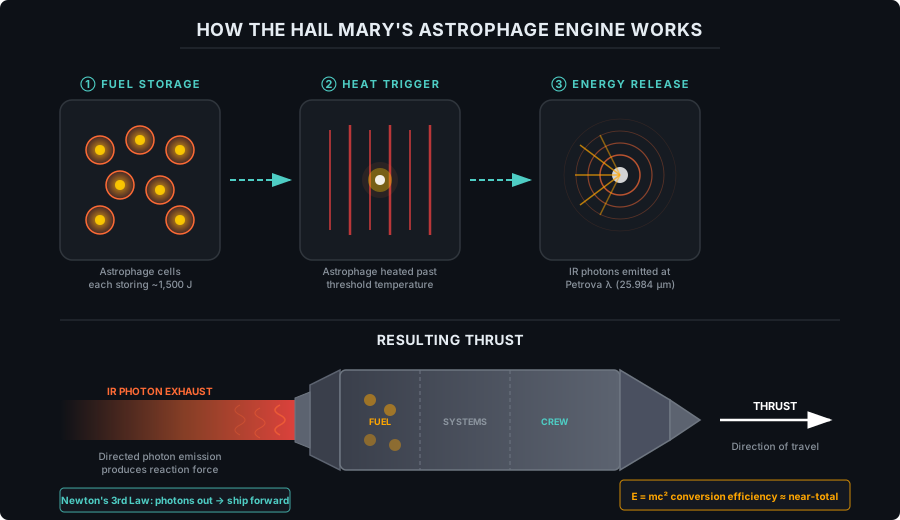
Astrophange engine
What makes the Hail Mary's engine remarkable from an engineering standpoint is what it doesn't need. There are no turbines, no generators, no heat exchangers, and no working fluid. A chemical rocket converts chemical energy to thermal energy to kinetic energy of exhaust gas — three conversions, each with losses. A nuclear thermal engine heats a propellant like hydrogen through a reactor — two conversions plus the mass penalty of the reactor and shielding. The astrophage engine has essentially one conversion: stored photon energy back to emitted photon energy. The fuel, the energy source, and the propellant are all the same thing. Astrophage goes in, light comes out, and the ship accelerates.
This also means the engine has no moving parts in the traditional sense. There's no combustion chamber pressure to contain, no turbopump feeding propellant at thousands of PSI, no throat erosion from superheated gas. The engineering challenges shift to thermal management — controlling the heat input so astrophage releases energy at a controlled rate rather than all at once — and to focusing the IR emission into a coherent, directed beam rather than letting it scatter in all directions. A photon emitted sideways is wasted thrust.
E=mc² and Why Astrophage Breaks the Fuel Problem
To understand why astrophage makes interstellar travel possible in the novel, you have to start with Einstein's mass-energy equivalence: E=mc². This equation defines the theoretical ceiling for how much energy any amount of matter can contain. The speed of light squared is an enormous number — roughly 9 × 10¹⁶ meters squared per second squared — which means even a tiny amount of mass, if fully converted, represents a staggering amount of energy. A single kilogram of matter perfectly converted through E=mc² would release about 90 petajoules, enough to power the entire United States for a couple of days.
The problem is that no real-world energy source comes close to that ceiling. Chemical fuels like hydrogen and oxygen convert a vanishingly small fraction of their mass to energy — roughly 0.000001% of what E=mc² permits. Nuclear fission does better, converting about 0.1% of fuel mass to energy. Fusion improves on that, reaching around 0.7%. Even these improvements, impressive as they are, leave most of the theoretical energy budget on the table. The only process that achieves full mass-to-energy conversion is matter-antimatter annihilation, which is why physicists love it on paper and engineers dread it in practice — we can't produce or store antimatter in meaningful quantities.
Astrophage sidesteps this entire ladder. Weir implies that astrophage stores energy at an efficiency approaching the E=mc² theoretical maximum. The organism absorbs stellar radiation — photons pouring off a star's surface — and packs that energy into its cellular structure at a density that no chemical bond or nuclear reaction can match. When Grace and the narrative describe astrophage as having roughly the energy density of antimatter, this is what they mean: each gram of astrophage holds energy approaching what E=mc² says a gram of matter can theoretically contain.
This is what collapses the mass ratio problem for the Hail Mary. With conventional fuels, an interstellar ship would need to be almost entirely fuel by mass — exponentially more fuel to carry the fuel to carry the fuel. With astrophage operating near the E=mc² limit, you need dramatically less fuel mass for the same energy output. The ship can be small enough to build, carry enough fuel to accelerate and decelerate, and still have mass budget left for crew, life support, and scientific equipment. Without this near-perfect conversion efficiency, the mission profile Weir describes would be impossible even within the novel's own physics.
The Numbers Behind the Trip
Weir doesn't hand-wave the performance specs. The Hail Mary accelerates at approximately 1.5g for extended periods, reaching a significant fraction of the speed of light. The ship travels roughly twelve light-years to the Tau Ceti system, with enough fuel for acceleration, deceleration, and a return trip — though the return fuel serves as an important plot point.

Grace in the Tau Ceti system from the movie Project Hail Mary
To appreciate how aggressive this is, consider that the fastest human-made object, the Parker Solar Probe, travels at about 0.06% the speed of light. The Hail Mary needs to reach somewhere in the range of 10–15% of light speed to make the journey in the timeline the novel describes. Getting a spacecraft with significant mass to that velocity and then stopping it at the destination requires a fuel with an energy density that simply doesn't exist in known physics. Conventional fuels fall short by many orders of magnitude.
This is where astrophage occupies a clever narrative sweet spot. It's biologically implausible but physically consistent. Weir doesn't violate conservation of energy — astrophage absorbed that energy from Tau Ceti's star (and our Sun) in the first place. He just proposes an organism that can store stellar energy at a density approaching theoretical limits. The engineering of the ship itself — engines, fuel tanks, structural design — follows logically from that single fictional premise.
What Would It Take in Reality?
Strip away astrophage, and the Hail Mary's engineering challenges map onto real problems in interstellar propulsion research. The ship needs high energy density fuel, efficient energy-to-thrust conversion, radiation shielding for relativistic travel, and life support for a years-long mission. These are the same problems that organizations like Breakthrough Starshot and NASA's Innovative Advanced Concepts program are studying today.
The most realistic near-term analog might be laser-driven light sails — an external energy source pushes the craft via photon pressure, sidestepping the fuel mass problem entirely. But light sails can't decelerate at the destination without a second laser array waiting there, which is a problem the Hail Mary's onboard fuel neatly avoids. Fusion propulsion is another candidate, and if we could build a working fusion drive with high specific impulse, the performance gap would narrow considerably — but we'd still fall short of astrophage's near-E=mc² energy density.
Why This Matters for the Story
Weir built the Hail Mary's propulsion system so carefully because the ship isn't just transportation — it's a ticking clock. The fuel supply constrains every decision Grace makes. The mass budget determines what he can bring home. The engine performance defines how long he has at Tau Ceti before he has to leave. Every clever hack and desperate improvisation in the second half of the novel flows from the engineering realities Weir established in the first half.
That's what separates great science fiction spacecraft from forgettable ones. The Hail Mary feels real not because every detail is physically possible, but because every detail is physically consistent. One impossible thing — astrophage — and everything else follows from real engineering logic.
For anyone who read the novel and wondered whether the ship could actually work: almost. You just need to find the organism first.


Comments
Loading comments...