
How AI Is Helping Scientists and Doctors Find Cures Faster
AI is transforming medicine from drug discovery to cancer diagnostics. How machine learning designs molecules no chemist imagined, catches cancers earlier, and is accelerating the path from lab to cure.
In 2020, DeepMind's AlphaFold solved a problem that had stumped biologists for fifty years: predicting how a protein folds into its three-dimensional shape from nothing but its amino acid sequence. That might sound abstract, but protein folding is the foundation of nearly everything in medicine. Every drug you've ever taken works by interacting with a protein. Every disease you've heard of involves proteins misbehaving. And until AlphaFold, figuring out a single protein's shape could take a PhD student an entire career. The AI did it in minutes.
That moment wasn't the starting gun for AI in medicine — researchers had been building toward it for years. But it was the moment the field's center of gravity shifted. What followed has been a cascade of breakthroughs across drug discovery, cancer diagnostics, and neurodegenerative disease research that is starting to change how we find treatments and, in some cases, how quickly we find cures.
What AI Actually Does in Drug Discovery
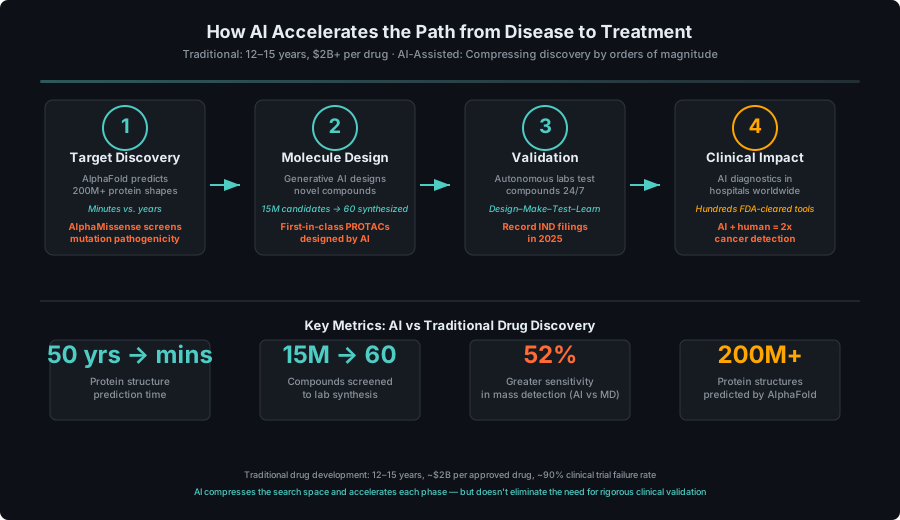
How AI Accelerates the Path from Disease to Treatment
Traditional drug development is a brutal process. It takes an average of 12-15 years and costs over $2 billion to bring a single drug from concept to pharmacy shelf. Most of that time and money is spent on failure — roughly 90% of drug candidates that enter clinical trials never make it to approval. The bottleneck isn't a lack of ideas. It's the sheer number of molecular possibilities that need to be tested, synthesized, and validated.
AI compresses that search space dramatically. Instead of screening millions of compounds in a physical lab, machine learning models can evaluate billions of molecular structures computationally, predicting which ones are likely to bind to a disease target, which will be toxic, and which will actually survive the journey through a human body.
Novartis demonstrated this in practice by using generative AI to computationally design 15 million potential compounds for a single drug program. Their predictive models assessed properties like brain penetration and metabolic stability before anything touched a test tube. Out of those 15 million candidates, they synthesized about 60 in the lab. That's not a typo. The AI narrowed 15 million options down to 60 promising ones — a filtering ratio that would have been physically impossible with traditional methods.
Designing Molecules That Didn't Exist Before
The more striking development isn't just filtering known compounds faster — it's designing entirely new ones. Generative AI models, similar in architecture to the large language models behind ChatGPT, can now propose novel molecular structures that no chemist has ever conceived. These aren't random guesses. The models learn the grammar of chemistry — which atomic arrangements are stable, which shapes fit into specific protein pockets, which configurations avoid the metabolic pitfalls that kill most drug candidates.
Insilico Medicine pushed this further in 2025 by using their Chemistry42 platform to design a first-in-class PROTAC molecule targeting PKMYT1, a protein linked to several cancers. PROTACs are a relatively new class of drug that work by tagging unwanted proteins for destruction by the cell's own recycling machinery, rather than just blocking them. Designing one from scratch is exceptionally difficult because the molecule has to simultaneously bind two different proteins and bring them into proximity. The AI managed it, producing a candidate with a dual-action mechanism that human chemists would have struggled to conceive through conventional approaches.
2025 also saw the highest single-year jump in IND (Investigational New Drug) filings for AI-originated molecules, with companies like Recursion, BenevolentAI, and Generate Biomedicines pushing candidates into clinical trials across oncology, fibrosis, and rare diseases. No AI-discovered drug has achieved FDA approval yet — that milestone is widely expected in the next two to three years — but the pipeline is filling fast.
How Protein Folding Unlocked a New Era of Medicine
To understand why AlphaFold mattered so much, consider what proteins actually do. They're the workhorses of biology — enzymes that digest food, antibodies that fight infection, receptors that let neurons fire. A protein's function is determined entirely by its 3D shape, which emerges from the way its chain of amino acids twists and folds. Misfolded proteins cause Alzheimer's, Parkinson's, and prion diseases. Understanding the shape means understanding the disease.
Before AlphaFold, determining a protein's structure required X-ray crystallography or cryo-electron microscopy — techniques that are expensive, slow, and sometimes simply don't work for certain proteins. AlphaFold predicted the structures of over 200 million proteins, essentially the entire known protein universe, and made the database freely available to researchers worldwide.
The downstream effects have been enormous. Google DeepMind's AlphaMissense tool, built on AlphaFold's foundation, can now assess whether a specific genetic mutation will cause a protein to malfunction. For cancer research, this means scientists can rapidly prioritize which mutations to study — instead of spending years investigating a single genetic variant, they can screen thousands computationally and focus lab resources on the ones most likely to matter.
A collaboration between UCSF's Institute for Neurodegenerative Diseases and SandboxAQ is applying a new class of AI called large quantitative models to Parkinson's and ALS research, using protein structure predictions to identify drug targets that were previously invisible.
AI-Powered Diagnostics: Catching Cancer Earlier
Drug discovery gets the headlines, but AI's impact on diagnostics may save more lives in the near term. The logic is simple: the earlier you catch a disease, the better the treatment outcomes. And AI turns out to be exceptionally good at pattern recognition in medical images — often better than the humans who trained on them for a decade.
In breast cancer screening, AI models have demonstrated accuracy matching or exceeding expert radiologists. A study published in Nature showed that Google Health's AI outperformed human specialists in interpreting mammograms, reducing both false negatives (missed cancers) and false positives (unnecessary biopsies). In lung pathology, a deep learning model called CheXNeXt showed 52% greater sensitivity in detecting masses and 20% greater sensitivity for nodules compared to board-certified radiologists, while maintaining comparable specificity.
The key insight isn't that AI should replace radiologists — it's that the combination is more powerful than either alone. One study found that pairing AI triage with a human reader doubled the detection rate of malignant nodules. The AI catches patterns the human eye might miss on a Tuesday morning after reviewing 80 other scans. The human catches the contextual nuances that the model wasn't trained on. Together, they're catching cancers that would have been missed entirely just a few years ago.
As of late 2025, hundreds of AI-enabled diagnostic tools have received regulatory clearance for medical imaging, and clinical adoption is accelerating globally. The FDA published draft guidance in early 2025 establishing a risk-based framework for assessing AI models used in clinical contexts — a signal that regulators are taking the technology seriously enough to build formal structures around it.
The Honest Limitations
It would be irresponsible to write about AI in medicine without acknowledging where it falls short. The technology is powerful but not omnipotent, and the gap between a promising computational prediction and a working drug remains enormous.
The fundamental challenge is biology's complexity. A molecule that looks perfect in simulation may fail in a living organism for reasons the model couldn't predict — unexpected immune reactions, off-target binding, problems with how the body absorbs or eliminates the compound. AI can accelerate the search, but it can't eliminate the need for rigorous clinical testing. The 90% failure rate in clinical trials exists because human biology is messy, variable, and stubbornly resistant to shortcuts.
There's also the data problem. Machine learning models are only as good as the data they train on, and medical data is notoriously fragmented, biased, and incomplete. Most training datasets overrepresent certain populations and underrepresent others, which means AI-discovered drugs and diagnostic tools may not work equally well for everyone. This isn't a hypothetical concern — it's an active area of research and a real barrier to equitable deployment.
A 2025 MIT study found that nearly 95% of enterprise generative AI pilots failed to deliver measurable business impact, often because the systems remained disconnected from real workflows and data infrastructure. Medicine is no exception. The gap between a flashy demo and a tool that integrates cleanly into a hospital's diagnostic workflow is substantial.
Where This Is All Heading
The trajectory is clear even if the timeline isn't. Pharmaceutical companies are building dedicated AI supercomputers and autonomous robotic laboratories that can run experiments around the clock without human intervention. Some labs have deployed robotic systems capable of independently designing, synthesizing, and testing compounds — closing the loop between computational prediction and physical validation.
In January 2026, SOPHiA GENETICS announced a collaboration with MD Anderson Cancer Center to co-develop next-generation sequencing tests using AI-powered analytics. Oxford Drug Design reported successful in vivo validation of novel therapeutics designed entirely by their generative AI platform. The technology isn't arriving — it's here, working its way through the slow but necessary process of clinical validation.
The first AI-discovered drug to receive FDA approval will likely happen within the next few years. When it does, it won't be a magic bullet. It'll be one drug, for one disease, approved after years of testing. But it will represent something genuinely new: a medicine that no human mind designed, found by an intelligence that can search chemical space at a scale we never could. And behind it will be a pipeline of hundreds more, each one discovered faster and cheaper than the last.
The fifty-year protein folding problem took AlphaFold a few minutes. The next fifty years of medicine will look very different because of it.


Comments
Loading comments...