
Where's My Hoverboard?
Back to the Future promised hover tech by 2015. It's 2026 and we're still grounded. But a former NASA engineer's propellantless drive has my attention.
In Back to the Future Part II, Marty McFly steps onto a hoverboard in the year 2015. It just works. No track, no copper surface, no fans screaming at 45,000 RPM. He kicks off and floats. That movie came out in 1989. I was a kid watching it, absolutely certain that by 2015 we'd have figured this out.
It's 2026. We have not figured this out.
And I'm not being cute about it. This isn't an ironic "haha we don't have jetpacks" complaint. I'm actually bummed. Hover technology was supposed to be the thing. Instead we've gotten a series of half-measures that mostly just remind you how far off the real thing still is.
What We Actually Have
Maglev trains are impressive, genuinely. But they need a purpose-built track with precisely arranged magnets the entire route. You can't take a maglev anywhere the track doesn't go. That's not hovering. That's a fancy rail system.
The Hendo Hoverboard showed up in 2014 and got a ton of press. It actually levitates, which is cool. The catch? It only works over copper or aluminum surfaces. Build a skatepark out of copper sheeting and you're golden. Step off that surface and you're standing on an expensive paperweight.
And then there's the ArcaBoard. Basically a person-sized drone. Thirty-six electric fans, 82 kilograms of hardware, six minutes of flight time if you're lucky. Fifteen grand. It's loud, unwieldy, and honestly terrifying to stand on. Not what the movies promised.
None of these are real hover technology. They're workarounds. Clever ones, sure. But workarounds.
The Most Interesting Thing I've Seen
Which is why I perked up when I read about Charles Buhler and Exodus Propulsion Technologies. Buhler spent decades running NASA's Electrostatics and Surface Physics Laboratory at Kennedy Space Center. Not some guy in a garage (though his thrusters are partially built from Styrofoam, which I love). He and his team claim to have built a propellantless propulsion drive. No exhaust. No expelled mass. Just electric charges producing force.
The simple version: the device uses lopsided electric fields to generate thrust directly. Buhler's team calls it the "Exodus Effect." They claim it produced enough force in vacuum chamber tests to counteract Earth's gravity on the thruster surface itself. Over 4,500 tests. And their patent sat under national security review for two years before the USPTO finally issued it, which is at least an interesting detail.
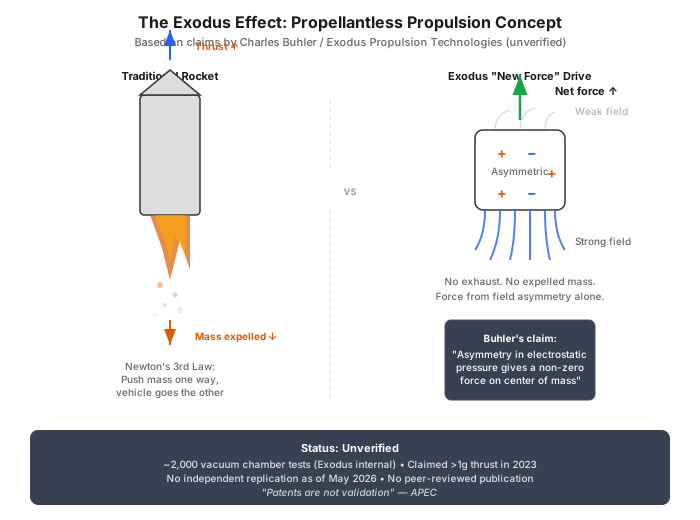
How the design works
If that sounds like it violates the laws of physics, a lot of physicists would agree with you. Newton's third law says every action needs an equal and opposite reaction. A drive that generates force without pushing something out the back shouldn't be possible. The theoretical framework Buhler points to is Quantized Inertia, a controversial theory from physicist Mike McCulloch at the University of Plymouth that tries to explain inertia as a quantum effect tied to the observable universe. Wild stuff. Deeply contested. But DARPA funded a $1.3 million study on it in 2018, so someone with serious money thought it was worth a closer look.
I Want to Believe, But...
Look, I want this to be real. But none of it has been independently verified through peer review. Buhler says they've tested it "nearly every way conceivable on Earth," and they're working on a paper. Until outside labs replicate the results and actually publish, it sits in a frustrating limbo. The kind where you can't dismiss it but you can't trust it either.
I've watched enough "breakthrough" propulsion stories fizzle to know better. The EMDrive went through a similar hype cycle before fading out. But Buhler's background is legit, his methodology appears rigorous, and he's openly inviting other researchers to replicate the work. Good science welcomes scrutiny.
Why This Matters Beyond Hoverboards
Here's why I can't stop thinking about it. If the Exodus Effect turned out to be real, the implications go way past floating skateboards. Propulsion is the bottleneck in space travel. Every spacecraft we've ever built carries its own fuel, and most of that fuel gets burned just lifting the rest of the fuel. Brutal equation. Mars takes months with chemical rockets. The outer planets, years. Anything beyond our solar system? Basically unreachable in a human lifetime.
I built a solar system propulsion simulator a while back that lets you play with different drive types and really feel how vast even our own neighborhood is. A drive that didn't need propellant would rewrite everything.
Looking Up
So where does that leave us? Still hoverboard-less. Still watching sci-fi promises curdle into nostalgia. But maybe, just maybe, watching something new take shape at the edges of what we thought physics allowed. Buhler's team wants to send their device to space for a definitive test. If it works up there, everything changes. If not, we keep waiting.
I'll keep watching. Skeptically, but with my fingers crossed.


Comments
Loading comments...