
Could Xenonite Actually Exist? The Real Chemistry Behind Rocky's Impossible Material
Rocky's xenonite baffles Grace because xenon is a noble gas that hates to bond. But real chemistry, from Neil Bartlett's 1962 discovery to xenon difluoride and clathrate cages, shows how a solid xenon material could actually exist.

There's a moment in Project Hail Mary that got me thinking again on a rewatch last night. Grace watches Rocky build with xenonite, an impossibly tough construction material, and his brain snags on one detail. Xenon is a noble gas. It floats around as invisible atoms that refuse to bond with anything. So how is Rocky casting it into a solid you could build a spaceship out of?

Rocky's Xenonite sculpture of Grace from Project Hail Mary.
Andy Weir has admitted he didn't bother explaining xenonite. He called it "magic stuff" in an interview and moved on, which is a perfectly fine choice for a novel. But I couldn't let it go. I spend a lot of my time thinking about atoms and how they snap together, so the question nagged at me: is there any real chemistry that gets you from "xenon the gas" to "xenon the solid brick"? The answer is more interesting than magic.
Why xenon wants to be a gas
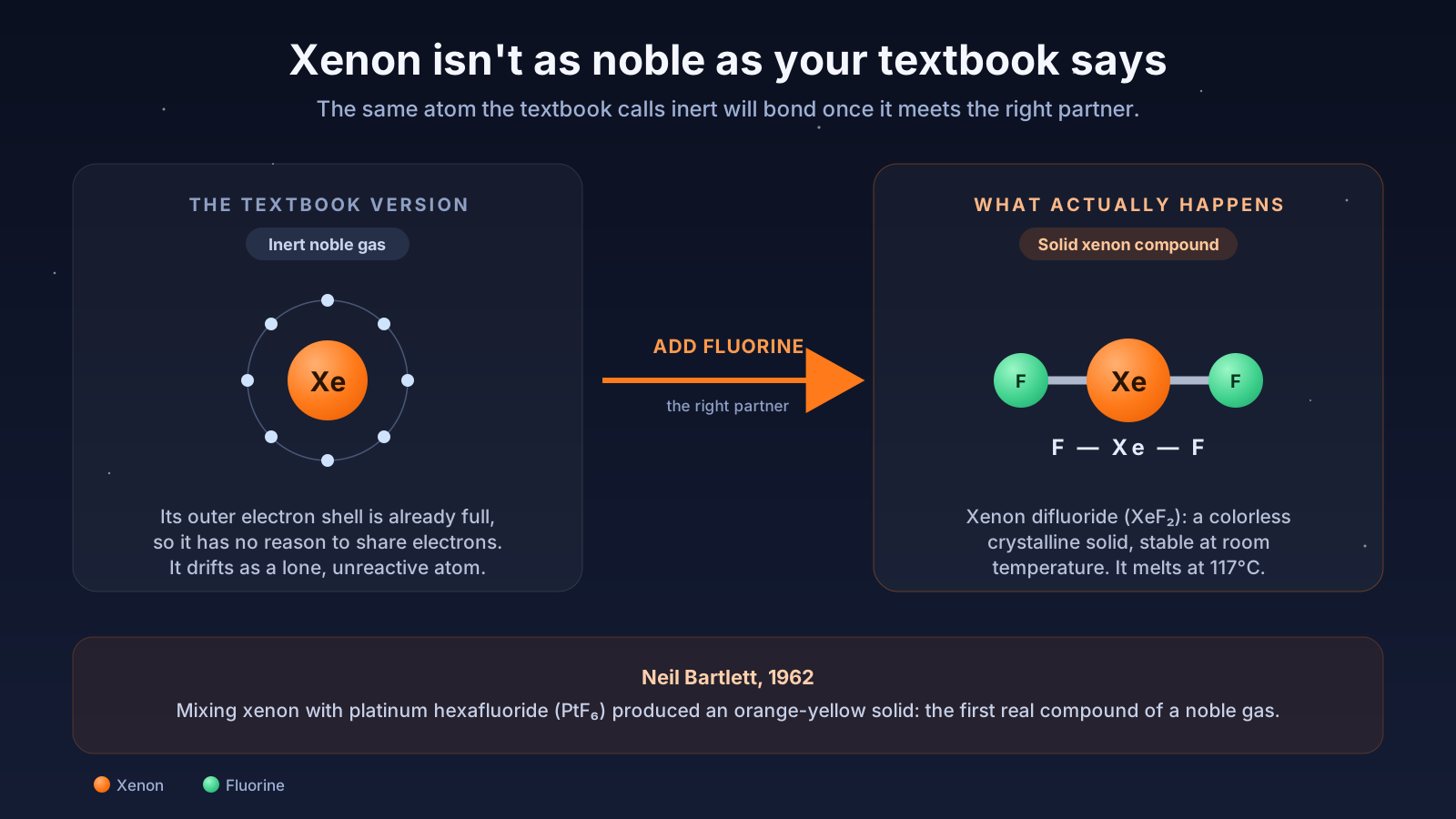
Start with why xenon is a gas in the first place. It's a noble gas, which means its outer electron shell is already full. A full shell is a chemically content atom. It has no real reason to share electrons with a neighbor, so xenon atoms mostly ignore each other and drift around as individuals.
The only thing pulling them together is a whisper of a force called van der Waals attraction, the faint stickiness that comes from electrons sloshing around and briefly making one side of an atom slightly negative. It's weak. So weak that you have to chill xenon to about -112°C (that's 161 kelvin) before those whispers are enough to lock the atoms into a solid. At room temperature the atoms have way too much energy to hold still. That's the version of xenon Grace has in his head, and he's right. Pure, frozen xenon is a cryogenic novelty, not a building material.
But "pure frozen xenon" isn't the only way to trap xenon in a solid.
Xenon is not as noble as your textbook says
For decades chemists were certain the noble gases were completely unreactive. Then in 1962 a chemist named Neil Bartlett mixed xenon with a nasty red gas called platinum hexafluoride and watched an orange-yellow solid appear out of nowhere. He'd made the first real compound of a noble gas. It broke a rule everyone thought was ironclad.
Image
Here's the part that matters for xenonite. One of the compounds that came out of that line of discovery is xenon difluoride, or XeF2. It's a colorless crystalline solid. It sits stable on a shelf at room temperature and doesn't melt until 117°C. Read that again: a solid, room-temperature material with xenon chemically locked inside it already exists on Earth. Nobody needs alien technology for that.
So the trick isn't freezing xenon into a brick by force. The trick is convincing xenon to bond, and once it bonds, the material follows the rules of its bonds, not the rules of a lonely gas atom. If a real chemist can build a stable xenon solid out of xenon and fluorine, it's not a huge leap to imagine an Eridian with millions more years of materials science building something far tougher out of xenon and ingredients we haven't thought of.
The cage trick, and a spoiler-safe nod
There's a second route I find even more satisfying, because it explains a specific plot detail without me giving much away. Xenon can also get trapped inside a clathrate, which is a solid where one substance forms a lattice of tiny cages and another substance sits caged inside. Water does this. Under the right conditions it freezes into a structure full of little cavities, and a xenon atom will happily sit inside each one. The xenon isn't really bonded so much as it's imprisoned by the walls around it.
The word to hold onto there is cages. A material built out of cages is a material full of gaps. If you've finished the book, you already know why a porous, gap-riddled solid becomes weirdly important late in the story, when something very small needs to get through something that's supposed to be sealed. I'll leave it there. But it's a lovely example of Weir's instinct being chemically sound even when he waves the details away. A xenon solid built from cages would have exactly the kind of microscopic escape routes the plot needs.
Why this rabbit hole is my kind of fun

Xenon detail from Molecular, https://molecular.chriswest.tech
I build a 3D chemistry tool called Molecular where you can pull apart atoms and watch electron shells and bonds form in real time, so this is squarely the sort of question I like to sit with. If I dropped xenon into it, you'd see that full outer shell and immediately understand Grace's confusion. Then you'd add fluorine, watch the bonds lock in, and understand why XeF2 refuses to behave like a gas. The whole arc from "impossible" to "obvious" happens in the space of a few clicks, which is the exact feeling I chase when I design these tools.
Weir didn't owe us an explanation for xenonite. Good science fiction earns a little hand-waving. But what gets me is that he picked an element that sounds impossible and is quietly one atom of fluorine away from being real. Rocky's magic material has more chemistry behind it than Grace, or Weir, ever let on.


Comments
Loading comments...